
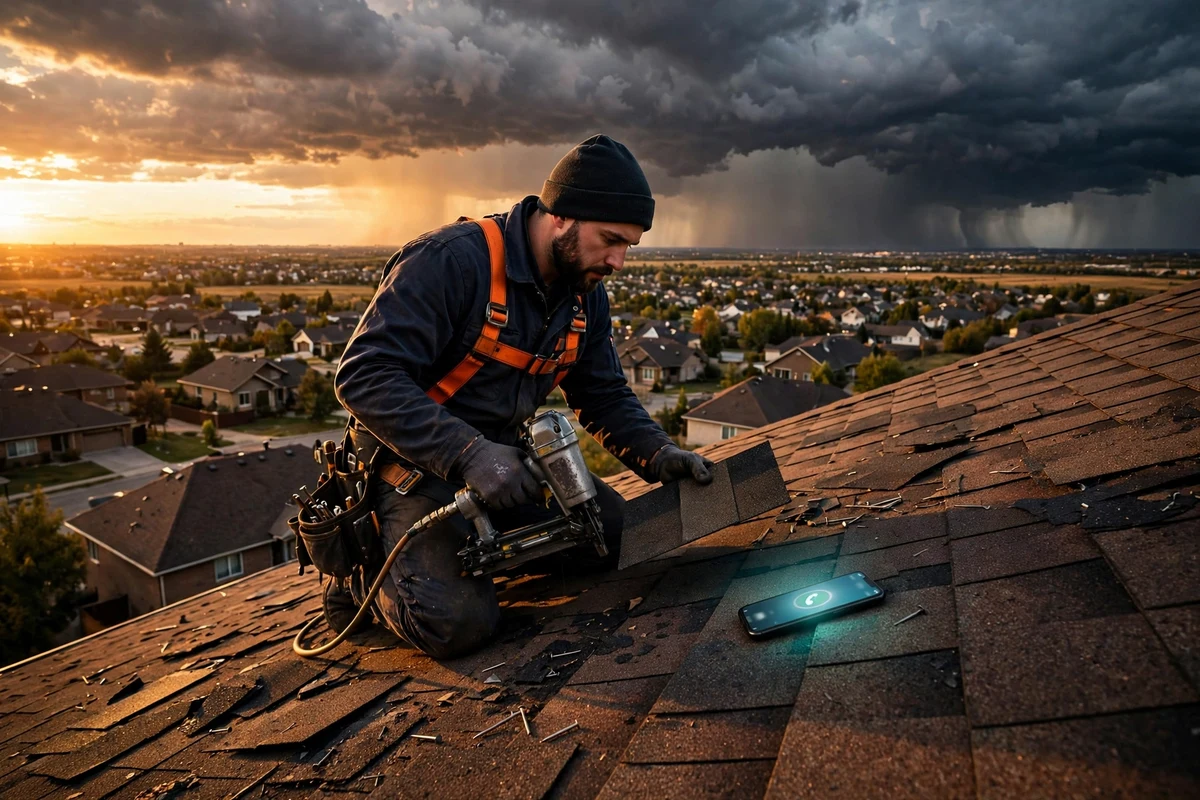
Short answer first: by taking the phone off the roof. A system answers every call around the clock, sorts active leaks from quote requests, books inspections into your calendar, and follows up on every estimate, so nobody has to climb down for a maybe. The stakes are in the research: industry research puts it at over 80 percent of first-time callers who reach voicemail hang up and dial the next company instead.
In this article
Why do roofing companies miss so many calls during storm season?
Because the work and the ringing peak at the same moment. A hailstorm rolls through on a Tuesday, and by Wednesday morning every damaged roof in the zip code is shopping. Your crews are tarping and climbing exactly when the phone rings hardest, and a small office cannot answer forty calls in an hour. The studies agree on the direction, as laid out in the research on our roofers page: BrightLocal found 62 percent of small business calls go unanswered, home service data puts roughly 27 percent of inbound calls missed, and 2026 call data from Invoca suggests close to half of home service calls never reach a person at all.
Your exact number depends on your office and your crews. What is not in doubt is the shape of the problem: the calls arrive in a surge, the surge lands on the busiest two days of your month, and the people who could answer are on roofs.
What happens when a homeowner reaches voicemail instead?
They hang up. Industry research puts it at over 80 percent of first-time callers who hit voicemail dial the next company instead of leaving a message. They do not wait, and they do not call back. They call the next roofer on Google, and the job you never heard about books with whoever picked up.
| Caller reaches voicemail | Caller reaches an answer | |
|---|---|---|
| What the homeowner does | Over 80 percent of first-time callers hang up and dial the next company | Explains the problem and books an inspection on the call |
| What lands in your system | Usually nothing: no message, no number, no record the call happened | The call, the triage notes, and the booking, logged in one pipeline |
| Who wins the job | The next roofer on Google who answered | You, if the inspection is booked before anyone else calls back |
Want your own number instead of the industry one? Run your last storm week through the Missed-Call Checker and see your missed-call count next to the published research.
Do homeowners really call roofers after hours?
Yes, and storm damage does not keep office hours. CallRail's 2026 data shows 41 percent of online-booked jobs arrive outside business hours. A homeowner watching a water stain spread across the ceiling at 10 PM calls whoever answers first, then signs with whoever shows up first. The 2 AM version is worse: an active leak will not wait for your office to open, and neither will the homeowner.
Watch Out: The usual fix, an on-call phone a person carries, breaks both ways. Treat every night call as an emergency and your on-call lead burns out by June. Treat none of them that way and a real leak ruins a ceiling, and your reputation, before morning. Somebody has to sort the active leak from the quote request at 2 AM, and it should not be a voicemail box.
Why does the first roofer to respond win the job?
Because the homeowner is not running a bidding process. They are standing under a drip with a phone in one hand. Remodeler case data shows 78 percent of homeowners award the project to the first responder. On a street where six roofs need work, the company that answers and books the inspection first usually writes most of the contracts, while better-known companies are still calling back.
Pro Tip: Book the inspection on the first call, not in a callback. A booked inspection is a commitment a homeowner waits for. A promise to call back is an invitation to keep dialing, and the research says they do.
Where do roofing jobs leak?
Four places, every week, in almost every roofing company we talk to. They are the same four we lay out on our roofers page:
| The leak | What happens | The fix |
|---|---|---|
| Hands on the roof | Nail gun in one hand, shingle in the other, three stories up. The call goes to voicemail and the caller dials the next roofer. | Answering that does not need your hands: every call picked up, day or night. |
| The post-storm surge | One storm produces a month of calls in two days. The office hears a busy signal or endless ringing, and the surge books with whoever picked up. | No busy signal and no hold queue: every surge call answered and triaged. |
| Estimate and insurance decay | You wrote the estimate and helped start the paperwork. Then silence. Adjusters move slowly, homeowners get busy, and the job drifts to whoever stays in front of them. | Timed, polite follow-up after every estimate and steady nudges while paperwork moves, in your voice. |
| The 2 AM leak dilemma | Every night call treated as an emergency burns out the on-call lead. None treated that way lets a real leak ruin a ceiling before morning. | Sorting on the call itself: active leaks get urgency and dispatch, quote requests get booked for the morning. |
What should answer the phone when your crew is on a roof?
A system built for the shape of roofing work. Business Hub OS answers your phone 24/7 on your existing number, sorts active leaks from quote requests, and gives simple guidance to limit water damage while help is dispatched by your rules. When a call does slip through, the caller gets a text back in seconds with a way to book an inspection, so the lead lands in your pipeline instead of on a shingle wrapper.
Inspections book straight into your calendar, and every call, text, and estimate sits in one place. The follow-up runs on its own: timed check-ins after every estimate and steady nudges while insurance paperwork moves, in your company's voice. When the homeowner replies, a person takes over. The full setup is on our roofers page.
Questions roofers ask us
Will callers know they are talking to an AI?
It is a natural voice conversation, and it identifies itself as your company's AI assistant when asked. Most callers are not shopping for a human. They want their leak handled fast.
Do I have to change my business number?
No. Business Hub OS works with your existing number, so your trucks, your yard signs, and your Google listing stay exactly as they are.
What happens when ten homeowners call at once after a storm?
Every call gets answered. There is no busy signal and no hold queue, so the post-storm surge that overwhelms a two-person office turns into a list of booked inspections in your CRM instead.
Can it follow up on estimates while insurance paperwork moves?
Yes. Timed, polite check-ins go out after every estimate, with steady nudges while the paperwork moves, written in your company's voice. When the homeowner replies, a person on your team takes over.
How do I find my own missed-call number?
Run your last storm week through the Missed-Call Checker: your real call volume, the share your team answers live, and your average job value, next to the published research.